Ecommerce Fulfillment Centers Explained: When Small Businesses Should Use Them
The moment a small e-commerce business starts losing weekends to packing boxes is the moment the fulfillment question becomes urgent. What began as a manageable part of running the business, printing labels at the kitchen table and making post office runs on the way to other errands, has become a daily operational demand that is consuming the time and energy that the business needs for the work that actually drives growth.
Ecommerce fulfillment centers exist to solve exactly this problem, providing the warehouse space, picking and packing labor, shipping relationships, and logistics technology that allow a growing e-commerce business to continue scaling without adding fulfillment infrastructure and labor proportionate to each unit of volume growth. Understanding what fulfillment centers actually do, what they cost, and when the economics of outsourcing fulfillment make sense relative to continuing to self-fulfill is knowledge that every product-based small business reaches a point of needing.
What Ecommerce Fulfillment Centers Actually Do
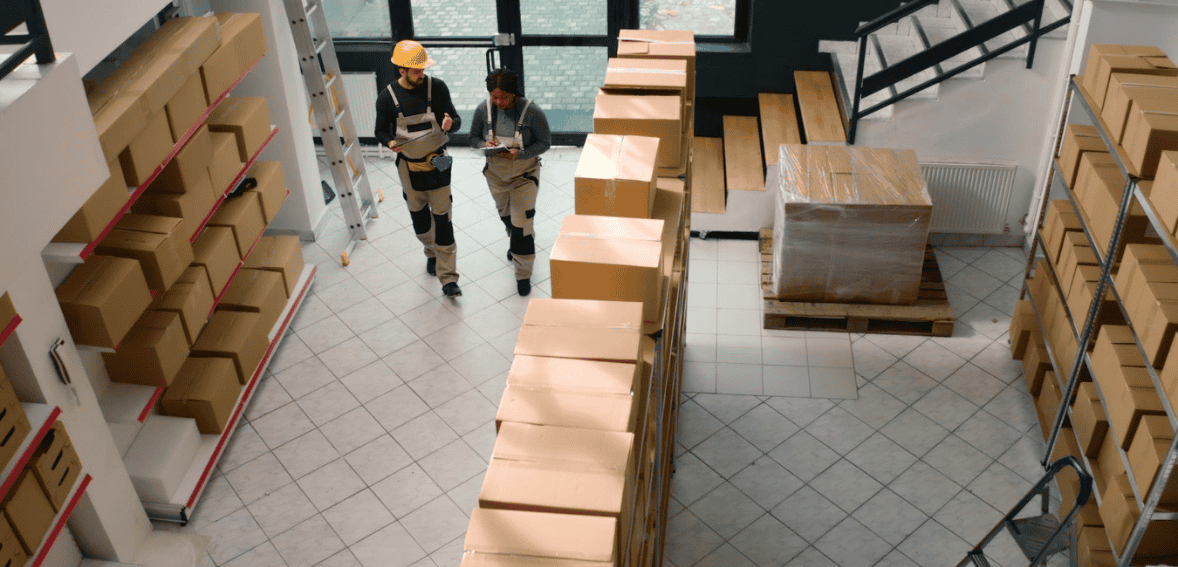
An ecommerce fulfillment center is a warehouse operation that stores inventory on behalf of multiple merchants and provides the full range of order fulfillment services from receiving inbound shipments from suppliers, to storing products in organized picking locations, to receiving orders electronically from the merchant’s e-commerce platform, to picking the ordered items, packing them in appropriate packaging, printing shipping labels, and handing the shipment to the carrier for delivery.
Third party logistics small business providers, known as 3PLs, run these fulfillment centers as a service company where individual merchants pay for the storage space occupied by their inventory, as well as the cost of labor and materials involved in the process of fulfilling their orders, instead of renting an entire warehouse for themselves and hiring employees to fulfill their orders.
The technological backbone of any fulfillment center today comprises warehouse management software, which can track in real-time the location and quantity of the inventory stored there, integration APIs which link up to the merchant’s e-commerce platform to get orders delivered automatically and provide tracking information, and reporting dashboards through which merchants can monitor their inventory levels, status of orders, and fulfillment costs from anywhere in the world, instead of visiting the fulfillment center physically.
Order fulfillment solutions offered by third-party logistics providers now also include added value solutions alongside picking, packing, and shipping, which may include product assembly or kitting, special packaging services, handling returns, and cold chain management for temperature sensitive products.
The Economics of Self-Fulfillment Versus Outsourcing
The decision to use a fulfillment center is fundamentally an economic decision that requires honest accounting of what self-fulfillment actually costs rather than only what it feels like as an operational burden.
3PL benefits are most clearly visible when the true cost of self-fulfillment is calculated to include all of its components, because the comparison between per-order 3PL fees and self-fulfillment costs looks very different when self-fulfillment costs include warehouse rent or the equivalent cost of the space used at home, packaging materials, the hourly cost of the owner’s time at the fully-loaded rate that reflects what that time is actually worth to the business, shipping carrier rates that a self-fulfilling small business pays compared to the negotiated rates that a high-volume 3PL can pass through to merchants, and the opportunity cost of the growth-focused activities that were not done because fulfillment was done instead.
Ecommerce fulfillment centers that process high volumes of orders from many merchants aggregate that volume into carrier rate negotiations that individual small businesses cannot access at their own volumes, and the shipping rate savings alone often partially or fully offset the 3PL service fees for merchants whose current carrier rates reflect small-volume pricing.
Order fulfillment solutions through 3PLs also convert the fixed costs of warehouse space and fulfillment labor into variable costs that scale with actual order volume, which improves the financial flexibility of a growing e-commerce business by eliminating the overhead commitment of maintaining fulfillment infrastructure during the low-volume periods that most seasonal businesses experience.
When the Timing Is Right for a Small Business
Third party logistics small business adoption timing is one of the most practically important questions that growing e-commerce operators face, because both too early and too late transitions create problems. Transitioning to a 3PL too early, before order volume is sufficient to justify the per-order fees and minimum commitment structures that most fulfillment centers require, can make the economics of 3PL outsourcing unfavorable relative to self-fulfillment at lower volumes.
Making the transition when it’s too late, at a point when fulfillment has already become a significant barrier to the growth and quality of the business, loses the business the advantage of having order processing take place during a time when order processing was slow, inefficient, or inconsistent due to the inability of the self-fulfillment process to handle all orders.
For most small businesses, the volume indicator that indicates the need for 3PL fulfillment centers is within fifty to two hundred orders per day. At this order level, the daily number of orders processed is large enough to make fulfillment consume a sizable amount of time in the day without being large enough that the business already has separate space in the warehouse dedicated to fulfilling these orders and dedicated personnel assigned to fulfill those orders. Advantages usually gained through 3PLs at this volume include better-than-cost efficiency, better shipping rates, lower loss rates due to professionalism, and increased flexibility of time.

Choosing the Right Fulfillment Partner
Order fulfillment solutions span a wide range of 3PL providers from large national networks with fulfillment centers distributed across multiple geographic regions to regional or specialized providers who focus on specific product categories, merchant sizes, or fulfillment requirements. The selection of a 3PL partner requires evaluation across several specific criteria that determine both the quality of the fulfillment service and the financial structure of the relationship.
Geographic distribution of fulfillment centers is a critical evaluation criterion because the distance between the fulfillment center and the end customer determines the transit time and the shipping cost for each order, and a 3PL with facilities concentrated on one coast will produce higher average shipping costs and longer average transit times for merchants whose customers are geographically distributed.
E-commerce fulfillment centers with facilities located in major coastal cities as well as in central hubs offer merchants the opportunity to distribute their inventories over several facilities and thus lower the distance and costs associated with delivery. Integration capabilities with the merchant’s e-commerce website are a necessity and not an option since the fulfillment company whose warehouse management system does not have the ability to integrate with the merchant’s Shopify, WooCommerce, and other e-commerce websites will need to manually process orders and thus lose the majority of advantages offered by the fulfillment service.
Price structure transparency is the most difficult criterion to estimate for merchants, since the 3PL price structure includes various types of fees, such as receiving, warehousing, fulfillment, packaging materials, and other fees that result in a per-order fee that differs substantially from the quoted prices.
Amazon FBA as a Fulfillment Option
For merchants who sell primarily through Amazon’s marketplace, Fulfillment by Amazon represents a specific 3PL option whose economics, capabilities, and constraints differ meaningfully from independent 3PL providers in ways that warrant separate consideration. Third party logistics small business options through FBA include access to Amazon’s extensive fulfillment network that provides Prime two-day shipping eligibility for FBA inventory, the customer service handling that Amazon provides directly for FBA orders, and the inventory management tools built into the Seller Central platform that give merchants visibility into their FBA inventory without a separate 3PL integration.
3PL benefits through FBA are most compelling for merchants whose sales are concentrated on Amazon’s marketplace and who value Prime eligibility as a significant competitive advantage in their product category. The constraints of FBA relative to independent fulfillment centers include the limitation to Amazon’s marketplace and the restrictions on using FBA inventory for direct-to-consumer orders placed outside Amazon, the storage fee structure that penalizes slow-moving inventory through long-term storage fees, the limited customization of packaging and unboxing experience that branded direct-to-consumer merchants value, and the dependency on Amazon’s policies, fee structures, and operational decisions that creates business risk for merchants whose fulfillment is entirely tied to a single platform’s infrastructure.
Managing the 3PL Relationship Effectively
The transition to a fulfillment center and the ongoing management of the 3PL relationship require operational disciplines that merchants who have been self-fulfilling often underestimate. Ecommerce fulfillment centers are logistics operations that depend on accurate product information, consistent inbound shipment quality, and clear communication of packaging requirements to produce the fulfillment accuracy that merchant and customer experience requires.
Order fulfillment solutions that work well in practice are those where the merchant has invested in providing the 3PL with accurate and complete product data, clear packaging and handling specifications, and timely inbound shipment notifications that allow the fulfillment center to plan receiving capacity appropriately. The ongoing management of a 3PL relationship requires monitoring key performance metrics including order accuracy rates, on-time fulfillment rates, damage rates, and inventory accuracy, because the financial and customer experience consequences of fulfillment errors at scale are significant enough that performance monitoring and service level accountability are not optional aspects of the relationship.
Merchants who treat the 3PL relationship as a set-and-forget outsourcing arrangement rather than as a managed vendor relationship consistently experience more fulfillment problems than those who maintain active communication, review performance data regularly, and address quality issues promptly.
Conclusion
Ecommerce fulfillment centers represent one of the most operationally transformative decisions available to growing small businesses, enabling the scaling of order volume without the linear increase in owner time, warehouse space, and fulfillment labor that self-fulfillment requires. Third party logistics small business adoption at the right volume and with the right partner converts fulfillment from an operational constraint on growth into a professional logistics capability that supports the business’s growth ambitions. Order fulfillment solutions through well-chosen 3PL partners provide the shipping economics, the operational reliability, and the owner time freedom that make the transition from self-fulfillment to outsourced fulfillment one of the most impactful operational decisions a growing e-commerce business can make at the right moment in its development.